Wednesday, December 12, 2007

Lit Circle, deuxieme partie

Section A

This book is incredibly fascinating and haunting, as it not only explores the hidden underbelly of crime that our modern youth is partaking in, but it also glances into the psychology of pathological "evil". It follows an extraordinarily atypical teenage boy, Alex, and his brutally violent and sexually exploitive escapades, and chronicle how his criminal tendencies are an unremovable part of his psyche. Despite very mentally manipulative techniques designed to dislodge all ideas of destructive activity from his brain, Alex is still inclined towards rape and brutality, as well as his other favorite form of violence, virtuoso classical music.
Themes throughout the book include:
  • The concept of true criminality- Are humans born with an unremovable sense of violence that is simply buried under society's teachings?
  • Is removing criminal tendencies from people though mind-altering techniques ethical? Should the human brain be tampered with in order to eradicate dangerous people from society?
  • The line between music and  pure violence
  • Is someone who is merely altered to fit into society's norms worth anything as a person?
Section B
Literal Question: Why did Alex return to having a gang after being betrayed in the past?
Bigger Question: Why did Burgess have Alex gradually regain and then lose his passion for violence naturally? Was this intentional to prove a point about human character? If so, what does it prove?

Section C

pg 115: "Delimitation is always difficult. The world is one, life is one. The sweetest and most heavenly of activities partake in some measure of violence- the act of love, for instance; music, for instance."
This quote is very interesting as it probes into the idea that life cannot easily be dividied into good and evil- that many things that are considered to be holy, such as music, can be interpreted in terms of violence.

Sunday, December 9, 2007

Literature Circle Response

Since I am quite familiar with the general plot structure of the book "A Clockwork Orange", I cannot make a truly speculative prediction in terms of the direction that the book is taking. I know that Alex will proceed to be mentally proccesed through the Ludivco Technique in attempt to be converted into a model citizen.

When reading this book, I can only really imagine the world presented in terms of screenshots from the movie. I have not actually seen the movie, but I have seen stills from it, and therefore it has been rather difficult to formulate my own ideas of what Alex and his droogs actually look like. However, I do not have any idea of what Stanley Kubrick's vision of Alex's environment looks like, so that aspect has been left to my imagination. I envision Alex's world as one completely corrupted by material wants and greed, underscored by a rampant delinquent juvenile population. His world is overrun by selfish lawmakers and easily bribed policemen, and innocence is lost at a very early age. In this world, 10 year olds follow charming strangers into drunkeness and then their bedrooms, and laugh as they are drugged. The streets are incredibly unsafe, and schools for the negligent are filled to the brink.

This book is a very cynical take on a dystopian society, and in a twisted way seems to attempt to prove that human nature is the reason why utopia is never possible. Also, ironically, the glamorization of violence in this book reminds me of how the book itself is glamorized, and how Alex DeLarge is still a popular symbol in teen culture.

The only difficulty I had in reading this book was in deciphering the language of Nasdat, which is a dialect that Alex and his droogs use consistently, intermingling with regular English.

I solved this problem by researching the language and discovering multiple sites that serve as dictionaries. By seeing other peoples' translations of the dialect, reading the text became increasingly easier.

Friday, November 23, 2007

US WATER QUALITY

Averages
site 1.
pH 7; DO 7.25 ppm; temperature 19.5 degrees Celsius; turbidity 40 JTU; nitrates 2.5 ppm

site 2.
pH 8; DO 8 ppm; temperature 22 degrees Celsius; turbidity 36 JTU; nitrates 0.583333333 ppm

site 3.
pH 7.857142857; DO 4 ppm; temperature 22.85714286 degrees Celsius; turbidity 200 JTU; nitrates 1 ppm

site 4.
pH 7; DO 8 ppm; temperature 22 degrees Celsius; turbidity 100 JTU; nitrates 2 ppm

site 5.
pH 7.25; DO 3.5 ppm; temperature 20.5 degrees Celsius; turbidity 42.5 JTU; nitrates 2 ppm

SD Bay.
pH 7.176470588; DO 4 ppm; temperature 22.11764706 degrees Celsius; turbidity 40 JTU; nitrates 0.866666667 ppm

Shelter Island.
pH 7.333333333; DO 4 ppm; temperature 20 degrees Celsius; turbidity 40 JTU; nitrates 0.5 ppm


3a.

pH
The sites with the water with the lowest pH were Famosa Slough 1 and 4, both with an average pH of 7.
The site with the water with the highest pH was Famosa Slough 2, with an average pH of 8.
DO
The site with the water with the lowest dissolved oxygen content was Famosa Slough 5, with the DO of 3.5 ppm, while the sites with the highest DO were Famosa Slough 2 and 4, with an average of 8 ppm.
TEMPERATURE
The site with the warmest water was that of Famosa Slough 3, with the average temperature being 22.85714286. The site with the coolest water was from Famosa Slough 1, with the average temperature of 19.5.
TURBIDITY
The water samples with the highest turbidity were from Famosa Slough 3, with levels on average of 200 JTU. The water with the lowest turbidity was from Famosa Slough 2, with the average turbidity level being 36 JTU.
NITRATES
The site with the lowest level of nitrates was Shelter Island, with the average level being 0.5 ppm. The site with the highest nitrate level was Famosa Slough 1, with levels of 2.5 ppm.


3b.

The results attained were not very surprising, as they all seemed to match the descriptions provided for the various areas. For example, site #1 at Famosa Slough was described as being inhabited by birds, which is made possible because the water at the site was of a neutral pH, an ideal level for animal life. Another example of logical results is the high turbidity level of Slough site #3, which was a shallow area of water covering very loose mud, which explains its murkiness. The results of the Bay area testing sites also were quite logical. At shelter island, sea animals were found in the water, which accounts for the near-neutral pH, and low turbidity.

4b.

Famosa Slough has five different sites, all scattered around a large area encompassed by Famosa Boulevard and West Point Loma Boulevard. Site one is closest to a parking lot and furthest from the actual slough. Site two is slightly closer to the slough, but is still quite a distance from it. Site three is right on the edge of the slough. Site four is on an outlet of water leading away from the slough. Site five is the furthest from site 1, and is on a stream leading from the slough, flowing into a channel that leads to the San Diego River Estuary. The further from the slough that the sites were, the lower the turbidity level of the water would become, as site 1 had a turbidity level of 40 JTU while site 3 had a level of 200 JTU. This is probably due to the fact that the water in the slough is constantly flowing, which stirs up the mud underneath, which in turn causes the murkiness of the water to increase. Also, the areas with the most flowing water, sites 3 and 5, had the lowest dissolved oxygen levels. pH was not a very varied component of the water quality testing, as all sites ranged between a neutral, slightly basic pH level of 7 to 8. Temperatures increased as the water sites neared the actual slough, the highest temperature being at site 3.

4c.

The results for the bay samples were very close, their turbidity levels and dissolved oxygen content averages being the same. Shelter Island had a slightly higher pH than the San Diego Bay by a margin of 0.268628, Shelter Island's water having a pH of 7.333333333 and the bay having pH of 7.176470588. The San Diego Bay's average water temperature was higher than that of Shelter Island, the water being 22.11764706 degrees Celsius versus 20 degrees. The Bay's nitrate level was higher as well, measuring up to 0.866666667 ppm as opposed to 0.5 ppm from Shelter Island.

Friday, November 16, 2007

EEEEEEEEE :))))


WEEEEEEEEEEEE FOUUUUUUUUUUUUUUUUUUUND ENRIQUEEEEEEEEEEEEEEEEEEEE!!!!!!!!!!!!!!!

Friday, November 2, 2007

images

http://images.google.com/imgres?imgurl=http://www.irwinator.com/126/w706.JPG&imgrefurl=http://www.irwinator.com/126/sd5555.htm&h=1369&w=900&sz=304&hl=en&start=8&tbnid=JUw53eYi0MErcM:&tbnh=150&tbnw=99&prev=/images%3Fq%3Dmexican%2Blaborers%26imgsz%3Dxxlarge%26gbv%3D2%26svnum%3D10%26hl%3Den


http://images.google.com/imgres?imgurl=http://content.cdlib.org/ark:/13030/tf509nb607/hi-res&imgrefurl=http://content.cdlib.org/ark:/13030/tf509nb607%3F%26brand%3Doac&h=1536&w=1024&sz=165&hl=en&start=20&tbnid=I7jpDDFq7C4W8M:&tbnh=150&tbnw=100&prev=/images%3Fq%3Dmexican%2Blaborers%26imgsz%3Dxxlarge%26gbv%3D2%26svnum%3D10%26hl%3Den


http://www.gutenberg.org/files/13854/13854-h/images/image-272-1.jpg


http://www.clintoncountygov.com/Departments/Health/MPj03993070000%5B1%5D.jpg


http://www.customscorruption.com/graphics/sdtribune1.gif


http://www.floppingaces.net/wp-content/mexprotest4.JPG


http://www.mynuscript.com/ARTICLES/immig3.jpg


http://farm1.static.flickr.com/221/481359589_4bfaf740ee_o.jpg


http://answer.pephost.org/images/content/pagebuilder/44459.jpg


http://www.bringinghistoryhome.org/image_library/5_8/9-19.jpg


http://www.gutenberg.org/files/22210/22210-h/images/219.jpg

Tuesday, October 16, 2007

Questions for Enrique Morones

Tomorrow I will be on camera interviewing Mr. Morones, which I imagine will be a very embarrassing experience. I'm not exactly looking forward to it, but it is a necessary component of our project and I am willing to play the martyr and be filmed.

QUESTIONS

Mari: First of all, how did you become interested in this line of work?
Enrique: (answer)
M: What was your reason for founding Border Angels, and what exactly does it accomplish?
E: (answer)
M: So, what is a typical scenario for someone traveling from Mexico to the United States, who is hoping to create a better living situation for themselves and their families?
E: (answer)
M: Is it typical for families to travel together, and camp together? Or do they often get separated? What is the living situation like in the camps?
E: (answer)
M: Is there a lot of violence directed towards these immigrants?
E: (answer)
M: Do you see a lot of obvious prejudice and people talking poorly to migrant workers, even those who have obtained legal status?
E: (answer)
M: You’ve been openly received by many human rights’ advocates, what is it about Border Angels that makes it so successful and sets it apart?
E: (answer)
M: Now, on the other hand, you’ve received some pretty harsh criticism from your sort of rivals, the minute men. What would you say to them and the people who believe that what you’re doing is anti-patriotic, and hurtful to the United States.
E: (answer)

Sunday, October 14, 2007

I really don't know what we're supposed to blog about

Really, I have no idea and this is getting frustrating.

Thursday, October 11, 2007

mexico trip

I am extremely curious as to what will happen on the mexico trip, seeing as I'm not going to be going on it. I imagine that I will be given an assignment as an alternate for actually attending, which I am fine with. In a way, I'm just a little worried on how my absence in mexico will affect my groupmates, and the final project.

Monday, October 8, 2007

what am i supposed to blog about?

IDevenK


(http://www.btinternet.com/~martin.chaplin/explan.html)
This site pretty much explains, in chemical terms, that water is CRAZY!, and why. It explains its boiling temperature, melting point, thermal conductivity, and other properties. It could be a valuable source due to its chemically dense explanations, and scientific wording.

Sunday, October 7, 2007

waterz

(http://www.teachersdomain.org/sci/phys/matter/props/index.html)
This site includes many interactive activities on different properties of water, such a buoyancy and and being a universal solvent. It also includes a wealth of information about different properties of other molecules, which is irrelevant to our project.

Friday, October 5, 2007

dah X2

Mari Jacobson
10/5/07
Per. 1/3
Agent Moffitt's visitation to our class proved to be very engaging and informational, and gave me a much better idea of what the job of a border patrol agent entails. It was an especially valuable talk for me, for prior to him coming into our class, I did not have a clear understanding of what the job goals and general aims of the border patrol were. I was not even certain of the exact role that the border patrol plays in the monitoring of illegal immigration, and was confused as to if the organization was in charge of creating legislation to control the flow of immigrants, or if its aims were to physically patrol the border and keep migrants out through force. After listening to his presentation about his job, I was able to completely understand his role in preventing illegal immigration.
In addition, it really struck me about his job how dedicated, unemotional, and patriotic one must be in order to be successful. I found it incredibly interesting that while he is a representative of an organization that is obviously anti-immigrant, he felt compassion and sympathy towards the border crossers. Despite feeling this way, he had to fulfill his duty to his employers and to his country of keeping such immigrants from crossing. I found it commendable that although his obvious biases, he was able to examine the opposite side of the argument and express those conflicting feelings of having to do his job but having his human instinct be to help out the people in need who he encounters.
This internal conflict really embodies the controversy of border patrol, and brings up the issue of maintaining the balance between compassion and protecting the status of the state. I found that Agent Moffitt's mentioning of this conflict was the most interesting part of his visitation, as it just emphasizes how the issue of immigration is not easily remedied because both sides are compelling, and multi-faceted. Although Agent Moffitt was a biased representative of the whole issue, I felt as though his talk was very effective due to the fact that he covered many aspects of the border patrol, not only just explaining the details of his day to day work, but also addressing the larger underlying issues behind illegal immigration.

DAH


im really stressed out >.<

Thursday, October 4, 2007

GSP reflection fo dp

The purpose of this project was to expand students' understanding of different transformations by creating intricate geometric designs. By creating complex designs that are precise by using Geometer's Sketchpad, and having to master the results of transformations in order to create those designs, students can have a hands-on learning experience and be tested on their knowledge at the same time.
The requirements of the project were to create
1. A simple design with at least 5-fold rotational symmetry, and to find the length of one line in the design and the corresponding linear equation by finding the slope and the y-intercept
2. A complex design that has at least 5-fold rotational symmetry
3. An Op Art piece
4. A knot or Islamic tile design
and in addition, three other simple designs, including an astrid and a triforce-type design.

all using the Geometer's Sketchpad program.


The geometer's sketchpad expanded my knowledge of geometric tranformations because creating a symmetrical design on the program takes a lot of prior experience with reflecting, rotating, and translating lines and objects. In order to create such a design, one must know about transformations, because in order to have lines go in certain directions or go to certain positions. Also, it was very effective in providing an example of what rotations, reflections, and translations create, and how these types of transformations are used in many geometric designs.

wwwaturz

(http://www.lsbu.ac.uk/water/)

This is a really annoying site, because of the way that it is set up and the information is presented, but it is also very informative. In essence, it is like a textbook. And while textbooks are arduous and mindnumbing, they do provide a wealth of information, and in that sense this site is very valuable.

LAIM beezy

(http://www.pbs.org/wnet/wideangle/shows/argentina/timeline1.html)
This is the PBS site for Argentina's independence, and like other PBS online articles, is extremely easy to read and clear-cut. Unfortunately, it focuses more on the aftermath of the indepence, as opposed to the events leading up to it, which isn't very helpful.


^^ I thought that this picture was very interesting, because of its caption: "A 16th century Spanish map of Río de la Plata. The exaggeration of the river and its tributaries reflects the colony's early appeal as a commercial port."


(http://www.onwar.com/aced/nation/all/argentina/fsanmartin1814.htm)
This is a NEAT site on the actual warfare of Argentina, and it provides good data about losses and military movements.
It also provides infomation about the parallels between Argentina, Chile, and Peru's independence movements, which is a neccessary component of the project.

(http://historicaltextarchive.com/sections.php?op=viewarticle&artid=403)
This provides a wealth of information on the issues that were posed concerning the independence of Argentina. Superfluous, perhaps, but interesting nonetheless.

Wednesday, October 3, 2007

deuxieme partie de l'eau

(http://www.extension.umn.edu/distribution/youthdevelopment/components/0328-02.html)
this site is uses very straightforward presentation of the properties of water. it pretty much just re-explains the information which I found in my textbook, covering such topics as how it can be in all three forms, surface tension, heat capacity, solvent abilities, and conductivity. it also includes experiments on how to prove these properties.

LAIM [José de San Martín]

(http://pachami.com/English/ressanmE.htm)
This site explains José de San Martín's correlation to the independence of Argentina. It also provides a sort of blow-by-blow description of the military side of the independence movement, including dates, which could prove to be very useful.


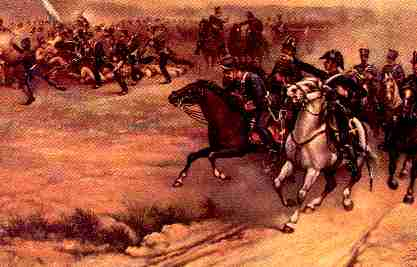
^^ this is a painting of the battle of Maipu. The caption on the site is "The United Argentine-Chilean army recovers and on April 5th they defeat completely the Spanish army in the battle of Maipu. That battle ended the Spanish efforts to dominate Chile."
from (http://pachami.com/English/maipu.jpg)

LAIM, deuxieme partie

(https://www.cia.gov/library/publications/the-world-factbook/geos/ar.html)
This is the CIA world factbook entry on Argentina, which includes a small overview of the history/independence of the country, as well as information about Argentina's current political situation.

(http://www.britannica.com/eb/article-33071/Argentina)
This is the Encyclopedia Britannica article on Argentinian independence. It is very clear-cut and understandeable, and presents a wealth of information on the topic. The article on Argentinean history as a whole is very extensive, even spanning back to the era of the Inca.

LAIM


from (http://en.wikipedia.org/wiki/Image:Flag-map_of_Argentina.svg)


(http://www.historyworld.net/wrldhis/PlainTextHistories.asp?historyid=ac09)
This site is like a mini-lecture on the history of Argentina, ranging from 1776 to 1916. It presents straightforward information on how the development of the state contributed to the independence movement.

Tuesday, October 2, 2007

textbook

I was reading my old biology textbook, and in it was included a wealth of information about the properties of water. Some of the topics covered by the book/ vocabulary words include:
-Electronegativity
-The polarity of Water
-Polar covalent bonds
-Water's polarity leads to hydrogen bonding and other unusual properties
-Hydrogen Bonds
-Cohesion
-Surface Tension
-Heat
-Temperatrue
-Ice is less dense than liquid water
-Water is the universal solvent


I will definitely bring the book into class, because it is very chemically involved and informative.

Monday, October 1, 2007

script

Script (2)

[shot of crowd milling through HTH]
(Mari) Most people have a pre-formulated concept about the lives of migrant workers and illegal immigrants in the United States.

[shot of Mari in front of interviewees]
(Mari) So, __________, what kind of lives do you think that illegal immigrants lead?
(Three peer interviewees) _______________________________

[photographs of Great Depression]
(narration) Latin American workers, which will be the main focus of our segment, started coming to the states during the Great Depression. Due to the ruined financial state of the country, their wages were often extremely low, and the labor was time-intensive and rough. Conditions were unforgiving and workers were rarely able to better their lives, having to keep working to barely escape bankruptcy.

[pictures of newspapers with articles on illegal immigration]
In the last decade, the issue of illegal immigration has become more and more pressing, and more awareness has arisen towards the problems that occur with the increasing presence of a migrant labor force.

We at Working Class Heroes Productions are going to discuss the problems that specifically affect those workers, such as housing and wages.

[statistics on a background]
Economically, the united states is more dependant on the flow of migrant labor than many would imagine. According to the Inter-American Development Bank, migrant workers in the United States sent home a collective $62.3 billion dollars in 2006, which is a 14% increase from 2005. Mexico, Brazil, and Colombia have the highest receiving rate of remittances. With the pressing issue of illegal immigration however, the INDB estimates that the number of remittances will begin to decline, which could have negative effects on the economies of not only the recipients, but the United States as well.


Migrant farm workers as a whole do not have adequate housing, and the issue is often glossed over by the government.

[shot of immigrant housing, taken while in Mexico]
In some circumstances, employers are not required to provide housing for their workers, and thus, it is upon the migrant worker themselves to find shelter for their families, on a sub par minimum wage. Also, if the worker does not have legal status, housing seems an even bigger nuisance, as many land lords mandate that tenants provide proof of legal residence. Those who speak out against the assimilation of illegal immigrants into US society, such as groups like the minute men, argue that this is knowledge that all illegal immigrants choose to accept, and that should they obtain legal citizenship the proper way. However, the current legal process is a taxing and time consuming affair that can take several years. Meanwhile, outsourcing of work seems to be increasing at a rapid pace, and creates difficult situations for the people in countries of which many migrant workers originate from, creating a cyclical pattern of opportunity forming into exploitation.


[group member in front of interviewee]
Here, we interview ___person___ on the subject of migrant workers.
(interview questions here).

Sunday, September 30, 2007

unrelated to project, spanish hw

PERSONAL
december 24th: el cumpleaños de mi hermano
february 27th: el cumpleaños de mi madre

INTERNATIONAL
december 25th: navidad
march 17th: Día de San Patricio
april 1st: día de los inocentes
march 23rd: pascua
may 5th: cinco de mayo
october 31st: día de las brujas

NATIONAL
last monday of may: día de la conmemoración
julio 4th: Día de la Independencia
first monday of september: día de trabajo
october 9th: día de Columbus
november 23rd: día de gracias
february 18th: día de los presidentes

plus des blogs

Vanessa's Blog
Vanessa's blog is more centered on the progress that her/my group is making, and less so on the actual information that she will be using for her project. However, she does make really good commentary on the sites which she does blog about, which provide good summaries about the research which she is doing.


Emlyn's Blog
Emlyn's blog is very entertainingly written, but is also has a lot of quality information posted onto it. His group ( i assume ) is researching border policy, which ties into our topic of the socioeconomic lives of migrant workers. Therefore, his information could prove to be valuable to our group, especially the data on the laws enforced upon illegal immigrants.


Alec's Blog
Alec is also in Emlyn's group, and his information also proves to be linked to our topic. He wrote a post which was a commentary on a post which Gino had made, which covered the issue of minimum wage, which is significant to our topic. The article which he wrote about was centered on how illegal immigrants affect the economy, and how they obstruct other people from other peoples' jobs.

http://www.ppic.org/content/pubs/cacounts/CC_207GPCC.pdf

Thursday, September 27, 2007

nicolette's blog

Nicolette's blog covers not only the progress of her (and my) group, but it also includes a lot of valuable information. By reading her blog, one can really track the progress that her group is making, and the direction in which it is taking its research. Since Nicolette is in my group, the information which she posted was not really new to me, as we have collaborated on the project already.

Monday, September 24, 2007

austin han's blog!

Austin Han's blog is pretty well organized, and is consistent as well. For every post, he comments on how the information is important for his project. Also, not only does he blog about information, but he mentions how he is feeling about the projects as well. Unfortunately, none of his information benefits me and my group's project, as his is about water quality, a topic completely different from the more humanities- oriented subject of socioeconomics.

Thursday, September 20, 2007

really good information

this site has really good, albeit biased, information about our topic. luckily, it has the same bias that my group does...
(http://knowledge.wharton.upenn.edu/article.cfm?articleid=1482)
also, i used this for our script:
(http://www.iplexingtonplant.org/ip_sued_over_migrant_workers_wages.htm)

script ROUGH

(Narration) Most people have a pre-formulated concept about the lives of migrant workers and illegal immigrants in the United States.
(Mari) So, __________, what kind of lives do you think that illegal immigrants lead?
(Three peer interviewees) _______________________________

In reality, migrant workers have had, for hundreds of years, lead lives of discrimination and difficulty. Many people may think of migrant workers as being solely mexican, but in reality, the history of immigrant labors stretches to many countries. Some early workers, from the 1800s, had roots in China and Japan, coming to California for a better life, but being met with poor conditions, low pay, and racism. Filipino workers, who came to the states in the 1890s after the Spanish occupation, were bound by unfair, discriminating laws that kept them in isolated, destitute conditions.

Latin American workers, which will be the main focus of our segment, started coming to the states during the Great Depression. Due to the ruined financial state of the country, their wages were often extremely low, and the labor was time-intensive and rough. Conditions were unforgiving and workers were rarely able to better their lives, having to keep working to barely escape bankruptcy.

In the last decade, the issue of illegal immigration has become more and more pressing, and more awareness has arisen towards the problems that occur with the increasing presence of a migrant labor force. According to the U.S. Census Bureau's March 2005 Current Population Survey," the U.S. is home to between 11.5 million and 12 million illegal immigrants, up sharply from 8.4 million in 2000. Unauthorized migrants accounted for 30% of all foreign-born people in the U.S. as of 2005. Most unauthorized migrants -- 6.2 million, or 56% of the illegal population -- come from Mexico. About 2.5 million, or 22% of the total, come from the rest of Latin America." In the same study it was established, "Approximately 19% of illegal workers were employed in construction jobs, 15% in production, installation and repair, and 4% in farming. The Pew report also shows that illegal immigrants comprise 24% of all workers in farming, 17% in cleaning, 14% in construction and 12% in food preparation. Within those categories, unauthorized migrants tend to be concentrated in specific jobs: They represent 36% of all insulation workers, 29% of all roofers and drywall installers, and 27% of all butchers and other food-processing workers."

We at ___news organization___ are going to discuss the problems that specifically affect those workers, such as housing, wages, and health issues.

Migrant farm workers as a whole do not have adequate housing, and the issue is often glossed over by the government.
According to the National Center for Farmworker Health, "The only national data on hired farmworker housing show that in 1980, available units could only house about 30 percent of the migrant farmworkers in need of housing". They also report that "Although some hired farmworkers live in well-kept housing, much of the housing available for them is deficient, crowded, and unsanitary. In addition, they often lack safe drinking water, bathing or laundry facilities, and even adequate sanitation."

Migrant workers are often underpaid as well. One example occured on January 27, 2006 when Georgia Pacific, International Paper, and Champion were sued for paying their workers unfair wages. The lawsuit alleged that "The workers got $100 to $200 a week for 60 or 70 hours of work and had to use part of that for transportation, housing and work tools", according to Reuters news association.

Here, we interview ___person___ on the subject of migrant workers.
(interview questions here)

Wednesday, September 19, 2007

documentary

(http://www.homelands.org/series/border.html)
I found this website, which is a good resource for documentaries/streams about current border conditions, which is NEATO because it is pretty much in a format that translates well to film.

Sunday, September 16, 2007

possible interview questions

:: How do the lives of Mexican migrant workers vary from the lives of workers from other countries?
:: What kind of issues do migrant workers face on a daily basis?
:: What is the typical income of a migrant worker?
:: What are the typical living situations of migrant workers?
:: Do migrant workers often have to support families/ How does that work out?
:: Are there any organizations dedicated towards helping out these workers?
:: Is there a lot of crime associated with migrant workers?
:: Is there a lot of violence directed towards migrant workers?
:: Are migrant workers often able to better their situations?
:: Are the families of migrant workers able to attain educations?
:: What kind of job opportunities do migrant workers have?
:: Due to increased awareness of immigration, are migrant workers having a harder time finding jobs?

atomic structure

(http://www.watertown.k12.wi.us/HS/Staff/Buescher/atomtime.php)

7. Neils Bohr: 1922
8. Schrodinger: 1930
9. Ernest O. Lawrence: 1929
10. Murray Gell-Mann and Kazuhiko Nishijima: 1961
11. Seaborg: 1941 - 51
12. 118 (Ununoctium)

Saturday, September 15, 2007

lives of migrant workers

Farmworker Housing

Farmworkers need decent, affordable housing in order to make the journey to perform the seasonal work needed. Without their labor, growers cannot maintain current production levels, thus creating food shortages that ultimately affect consumers in the form of higher prices. The number of farmworkers in need of housing exceeds the number of available housing units. The only national data on hired farmworker housing show that in 1980, available units could only house about 30 percent of the migrant farmworkers in need of housing. Hired farmworkers, particularly migrants, also face barriers to obtaining housing in the local private housing markets. Small rural communities may not have enough rental units available, or they may be unavailable to migrant farmworkers because they cannot provide deposits, qualify in credit checks, or make long-term rental commitments.

Agricultural employers recognize that the lack of housing is a serious problem, but they face several disincentives to providing housing for migrant farmworkers. The need of the farmworker population to find temporary housing has traditionally been met by growers through the establishment of labor camps. But construction and maintenance of housing is expensive, especially if the housing will only be occupied during a short harvest season. Some employer-provided housing does exist, but ironically, attempts to enforce housing standards have created a trend toward agricultural employers' discontinuing the provision of housing. As a result, workers may share a small, grower-provided room with several other people. In the absence of housing, farmworkers may be forced to sleep in tents, cars, ditches, or open fields.

Private housing is not subject to federal regulation. The private housing that is available to migrant workers tends to be substandard and many times expensive. Although some hired farmworkers live in well-kept housing, much of the housing available for them is deficient, crowded, and unsanitary. In addition, they often lack safe drinking water, bathing or laundry facilities, and even adequate sanitation.

The migrant labor force is important to the agricultural sector, which in turn is an important part of the overall local economy. It is clear that steps should be taken to help migrant farmworkers find solutions to their housing needs. There has been some progress with regard to farmworker housing.

For instance, the state of Florida is among the more active states in providing assistance for the development of farmworker housing. Among its programs is the State Apartment Incentive Loan Program, which provides mortgages for the construction or substantial rehabilitation of rental housing which is affordable to very low-income tenants.

The state of California operates state housing centers for migrant farmworkers and their families, and provides effective model programs for farmworker housing enforcement and development.

Finally, in Texas, Proyecto Azteca is a non-profit organization affiliated with United Farm Workers. The project has started a program to improve farmworkers' living conditions in the unincorporated villages, or colonias, in the Rio Grande Valley.

A study in Virginia analyzed how economic conditions on Virginia's Eastern Shore would change if migrant farmworkers were no longer available to local agricultural producers. Among other findings, the study found that the number of wage and salaried employees would decrease, in turn reducing consumer spending and having a subsequent negative impact on the retail and wholesale sectors. Farmworkers' presence enhances local economies through tax revenues from retail sales and property taxes.

(http://www.ncfh.org/aaf_02.php)


a good resource page is:
(http://www.emints.org/ethemes/resources/S00000429.shtml)

Wednesday, September 12, 2007

gods

Bolontiju, Lords of the Night
Coatlicue "She of the Serpent Skirt," is the goddess of the earth and mother of the gods, half-life and half death.
Ixtab --Goddess of the noose and the gallows.
Akhushtal -- Goddess of childbirth.
Quetzalcóatl--the god of civilization, and connected to the planet Venus and the wind.

(the last couple blogs were from mayan-kids.com)


http://www2.truman.edu/~marc/webpages/nativesp99/maya/conquest.html

mayan monkey myth

he Myth:
Long ago, men were made of wood. The wood people were punished by being destroyed, and those few who managed to survive, became monkeys. The gods refused to give up and then created a man made of maize (corn) .
In one version of the Popol Vuh -- Hero Twins named Hunahpu and Xbalanque were the Hero Twins. These Hero Twins had an earlier set of brothers: a Howler Monkey and a Spider Monkey.

These older brothers were accomplished artists and dancers. But they were also envious of their younger brothers, for they knew that their younger brothers would become the Hero Twins.

One day the older brothers took their younger brothers to hunt for birds with the intention of harming them. The older brothers climbed a tree that (through magical powers) knew of the evil intentions, The tree began to grow taller and taller, lifting the older brothers closer to the heavens.

The tree grew so high up that the older brothers were unable to climb down again. They loosened their clothes and tried to climb down but their loincloths became tails and they were changed into monkeys. The younger set of brothers ran to their grandmother.

When they brought her back to the scene, the older brothers, now turned into a Howler Monkey and a Spider Monkey, began to shake the limbs of the tree violently.

When the Hero Twins began to play a flute and beat a drum that the monkeys calmed down and began to dance. They climbed down the tree and followed their younger brothers back home.
These dancing monkeys were so funny that the younger brothers and grandmother laughed. Their feelings hurt at being laughed at, the monkeys ran away to the forest to live high in the trees forever. Throughout Maya villages in the highlands (Chiapas, Tabasco and Guatemala) men dress up as monkeys to do funny dances and perform mischief.

Monkeys are often associated with the sacred and the divine. Monkeys are shown on pottery in scenes of the underworld .

Maya monkeys live high in the forest canopy, outside of Cancun and Cozumel, suspended between the earth and the heavens. They can easily come and go between the ground and the highest point of the rain forest.

In the Temple of the Inscriptions in Palenque, the Sarcophagus Cover shows Pacal descending into the Underworld. On his belt is an image of a monkey.

There are two kinds of monkeys common in the Mexico Maya area: spider and howler. The spider monkey, with wiry, long limbs is a joyous creature.

His face is capable of many expressions and his disposition is kind. The howler monkey has less of an expression and its howls sound like someone crying. One Spider Monkey may be associated more with laughter and pranks, life and joy, while the Howler Monkey may be associated more with seriousness and work and duty. Spider monkeys laugh. Howler monkeys cry.

more!

Almost all the urban centers were built in tropical rain forest. This is the probably the biggest reason why the Mayans never developed a fully urban culture. Topical rain forest is difficult to live in. and can only support small groups of humans.

While plant and animal growth seems almost out of control and the rains never stop, tropical rain forest makes very poor farming land. A greater amount of area is required to support each person—and people tend to spread out rather than form cities.

Priests and noblemen would willingly pierce body parts, usually their tongue, ears or lips and "give" blood to the gods.

The more important a person was in their society, the more blood they were expected to give to the Gods


The feathered serpent is the god of civilization, and connected to the planet Venus and the wind. He represented the forces of good against those of evil. According to one legend, Quetzalcoatl was driven from the city of Tula, the Toltec capital, and wandered for many years until he reached his homeland, the east coast of Mexico.

general information

They built elaborate pyramids and observatories, all without metal tools.

The Mayas, like others who cultivated tropical rain forest, practiced cut and burn agriculture. Because growth is so rapid in tropical rain forests, the nutrients provided by dead plants and animal droppings gets used up very quickly. Rain forest soil is not fertile ground for growing crops.

In slash and burn agriculture, the Mayans would cut down a patch of forest, burn the felled trees and plants for fertilizer, and then cultivate the plot.

Because the Mayans did not replenish the land, their soil would be too poor for growing food in two to four years. It takes a lot of land to support a family. Each five people probably needed at least 70 acres to grow their food.


The indigenous tacos are of Charales, maguey worms, sweet water shrimps, ant spawn or escamoles, and even chapulines (a kind of crickets).


The molcajete is a pestle and mortar used for grinding spices. The metate is a flat version with a pestle shaped more like a rolling pin, used for grinding


their ball game:

The game appears in various myths, sometimes as a struggle between day and night deities, or the battles between the gods in the sky and the lords of the underworld. The ball symbolized the sun, moon, or stars, and the rings stood for sunrise and sunset, or equinoxes.

The losing team was usually sacrificed


Men wore an ex which is a loincloth--a cloth that covers as much as a small bathing suit. . Women wore loose sack like dresses. The clothes of the priests and nobles were made with finer materials and had many shells and beads on them. For ceremonies they wore wonderful head-dresses.


Most Mayas could read some hieroglyphs. But priests and nobles were probably the only people who knew the whole language. The Maya carved these symbols into stone, and made books from tree bark, called codexes


The Maya have been making ceramics the same way for centuries. To produce a bowl the potter sits on the ground before a wooden board. Using her hands she forms the flat base of the bowl. Then she builds up the sides by placing ropes of clay, called gusanos (worms) on the base. Once the coils are tall enough, she then smoothes out the clay. The potters hands, fingertips and palms are her main tools, though she will use a piece of rubber and/or the flat of a knife to work the piece to a smoother finish. Then the bowl is is left to dry in the sun for several days. Potters were mostly women

iiiiinteresting

http://cedarmesa.blogspot.com/2005_03_01_archive.html

Monday, September 10, 2007

mayan music

The mayans made music with instruments like flutes, rattling cups and drums. There is no evidence of stringed instruments in the ancient mayan culture. Their flutes were primarily in the shapes of animals and were made of materials like clay or wood.

(http://www.mayankids.com/mmkpeople/mkmusic2.htm)

Sunday, September 9, 2007

mayan maternity figure


(http://www.hurstgallery.com/exhibit/recent/PreHispanic/index.php)

mayan technology


The Mayans used blades carved out of stone for various activities, such as hunting and sacrificing.
Their diet primarily consisted of squash, beans, and corn, which were crops probably brought to the Guatamalan area from Mexico.
(http://worldmuseumofman.org/mayan1.htm)
Mayan Pottery
(http://www1.istockphoto.com/file_thumbview_approve/1072126/2/istockphoto_1072126_ancient_mayan_pot.jpg)

The Mayan Alphabet:


(http://www.omniglot.com/writing/mayan.htm)

Friday, September 7, 2007

mayanz holla


In the Mayan religion,
  • Life is a series of cycles, and each cycle ends with destruction
  • The next mass destruction is supposed to be in 2011/2012
  • The earth is flat and each corner represents a color, as well as with the sky. The central color of both the earth and the sky is green.
  • The sky, heaven, and hell all are composed of layers
  • There are around 166 gods
  • Priests were also in charge of timekeeping and astronomy
  • Ritual ceremonies were performed to keep religious articles anointed with blood
  • Human sacrifices were performed on people who were considered of lesser value
  • Some lords were cremated or mummified
(http://www.civilization.ca/civil/maya/mmc03eng.html)
(http://www.religionfacts.com/mayan_religion/index.htm)


Thursday, September 6, 2007

mayan pottery

for the indigenous peoples mini-project, i chose to research the pottery of the mayan people. i found a site with really good pictures of mayan pottery, which i definitely will be using for my visual aid.
(http://home.earthlink.net/~artemaya/id2.html)

Wednesday, September 5, 2007

immigrant workers

migrant worker news

Basically, I researched different policies on migrant workers to the United States, including Bush's policy
(http://www.cnn.com/2006/POLITICS/03/31/bush.cancun/index.html?iref=newssearch)
(http://www.cnn.com/2007/POLITICS/06/15/congress.immigration.bill/index.html?iref=newssearch)