Tomorrow I will be on camera interviewing Mr. Morones, which I imagine will be a very embarrassing experience. I'm not exactly looking forward to it, but it is a necessary component of our project and I am willing to play the martyr and be filmed.
QUESTIONS
Mari: First of all, how did you become interested in this line of work?
Enrique: (answer)
M: What was your reason for founding Border Angels, and what exactly does it accomplish?
E: (answer)
M: So, what is a typical scenario for someone traveling from Mexico to the United States, who is hoping to create a better living situation for themselves and their families?
E: (answer)
M: Is it typical for families to travel together, and camp together? Or do they often get separated? What is the living situation like in the camps?
E: (answer)
M: Is there a lot of violence directed towards these immigrants?
E: (answer)
M: Do you see a lot of obvious prejudice and people talking poorly to migrant workers, even those who have obtained legal status?
E: (answer)
M: You’ve been openly received by many human rights’ advocates, what is it about Border Angels that makes it so successful and sets it apart?
E: (answer)
M: Now, on the other hand, you’ve received some pretty harsh criticism from your sort of rivals, the minute men. What would you say to them and the people who believe that what you’re doing is anti-patriotic, and hurtful to the United States.
E: (answer)
Tuesday, October 16, 2007

Sunday, October 14, 2007
I really don't know what we're supposed to blog about
Really, I have no idea and this is getting frustrating.
Thursday, October 11, 2007
mexico trip
I am extremely curious as to what will happen on the mexico trip, seeing as I'm not going to be going on it. I imagine that I will be given an assignment as an alternate for actually attending, which I am fine with. In a way, I'm just a little worried on how my absence in mexico will affect my groupmates, and the final project.
Monday, October 8, 2007
what am i supposed to blog about?
IDevenK
(http://www.btinternet.com/~martin.chaplin/explan.html)
This site pretty much explains, in chemical terms, that water is CRAZY!, and why. It explains its boiling temperature, melting point, thermal conductivity, and other properties. It could be a valuable source due to its chemically dense explanations, and scientific wording.
(http://www.btinternet.com/~martin.chaplin/explan.html)
This site pretty much explains, in chemical terms, that water is CRAZY!, and why. It explains its boiling temperature, melting point, thermal conductivity, and other properties. It could be a valuable source due to its chemically dense explanations, and scientific wording.
Sunday, October 7, 2007
waterz
(http://www.teachersdomain.org/sci/phys/matter/props/index.html)
This site includes many interactive activities on different properties of water, such a buoyancy and and being a universal solvent. It also includes a wealth of information about different properties of other molecules, which is irrelevant to our project.
This site includes many interactive activities on different properties of water, such a buoyancy and and being a universal solvent. It also includes a wealth of information about different properties of other molecules, which is irrelevant to our project.
Friday, October 5, 2007
dah X2
Mari Jacobson
10/5/07
Per. 1/3
Agent Moffitt's visitation to our class proved to be very engaging and informational, and gave me a much better idea of what the job of a border patrol agent entails. It was an especially valuable talk for me, for prior to him coming into our class, I did not have a clear understanding of what the job goals and general aims of the border patrol were. I was not even certain of the exact role that the border patrol plays in the monitoring of illegal immigration, and was confused as to if the organization was in charge of creating legislation to control the flow of immigrants, or if its aims were to physically patrol the border and keep migrants out through force. After listening to his presentation about his job, I was able to completely understand his role in preventing illegal immigration.
In addition, it really struck me about his job how dedicated, unemotional, and patriotic one must be in order to be successful. I found it incredibly interesting that while he is a representative of an organization that is obviously anti-immigrant, he felt compassion and sympathy towards the border crossers. Despite feeling this way, he had to fulfill his duty to his employers and to his country of keeping such immigrants from crossing. I found it commendable that although his obvious biases, he was able to examine the opposite side of the argument and express those conflicting feelings of having to do his job but having his human instinct be to help out the people in need who he encounters.
This internal conflict really embodies the controversy of border patrol, and brings up the issue of maintaining the balance between compassion and protecting the status of the state. I found that Agent Moffitt's mentioning of this conflict was the most interesting part of his visitation, as it just emphasizes how the issue of immigration is not easily remedied because both sides are compelling, and multi-faceted. Although Agent Moffitt was a biased representative of the whole issue, I felt as though his talk was very effective due to the fact that he covered many aspects of the border patrol, not only just explaining the details of his day to day work, but also addressing the larger underlying issues behind illegal immigration.
10/5/07
Per. 1/3
Agent Moffitt's visitation to our class proved to be very engaging and informational, and gave me a much better idea of what the job of a border patrol agent entails. It was an especially valuable talk for me, for prior to him coming into our class, I did not have a clear understanding of what the job goals and general aims of the border patrol were. I was not even certain of the exact role that the border patrol plays in the monitoring of illegal immigration, and was confused as to if the organization was in charge of creating legislation to control the flow of immigrants, or if its aims were to physically patrol the border and keep migrants out through force. After listening to his presentation about his job, I was able to completely understand his role in preventing illegal immigration.
In addition, it really struck me about his job how dedicated, unemotional, and patriotic one must be in order to be successful. I found it incredibly interesting that while he is a representative of an organization that is obviously anti-immigrant, he felt compassion and sympathy towards the border crossers. Despite feeling this way, he had to fulfill his duty to his employers and to his country of keeping such immigrants from crossing. I found it commendable that although his obvious biases, he was able to examine the opposite side of the argument and express those conflicting feelings of having to do his job but having his human instinct be to help out the people in need who he encounters.
This internal conflict really embodies the controversy of border patrol, and brings up the issue of maintaining the balance between compassion and protecting the status of the state. I found that Agent Moffitt's mentioning of this conflict was the most interesting part of his visitation, as it just emphasizes how the issue of immigration is not easily remedied because both sides are compelling, and multi-faceted. Although Agent Moffitt was a biased representative of the whole issue, I felt as though his talk was very effective due to the fact that he covered many aspects of the border patrol, not only just explaining the details of his day to day work, but also addressing the larger underlying issues behind illegal immigration.

Thursday, October 4, 2007
GSP reflection fo dp
The purpose of this project was to expand students' understanding of different transformations by creating intricate geometric designs. By creating complex designs that are precise by using Geometer's Sketchpad, and having to master the results of transformations in order to create those designs, students can have a hands-on learning experience and be tested on their knowledge at the same time.
The requirements of the project were to create
1. A simple design with at least 5-fold rotational symmetry, and to find the length of one line in the design and the corresponding linear equation by finding the slope and the y-intercept
2. A complex design that has at least 5-fold rotational symmetry
3. An Op Art piece
4. A knot or Islamic tile design
and in addition, three other simple designs, including an astrid and a triforce-type design.
all using the Geometer's Sketchpad program.
The geometer's sketchpad expanded my knowledge of geometric tranformations because creating a symmetrical design on the program takes a lot of prior experience with reflecting, rotating, and translating lines and objects. In order to create such a design, one must know about transformations, because in order to have lines go in certain directions or go to certain positions. Also, it was very effective in providing an example of what rotations, reflections, and translations create, and how these types of transformations are used in many geometric designs.
The requirements of the project were to create
1. A simple design with at least 5-fold rotational symmetry, and to find the length of one line in the design and the corresponding linear equation by finding the slope and the y-intercept
2. A complex design that has at least 5-fold rotational symmetry
3. An Op Art piece
4. A knot or Islamic tile design
and in addition, three other simple designs, including an astrid and a triforce-type design.
all using the Geometer's Sketchpad program.
The geometer's sketchpad expanded my knowledge of geometric tranformations because creating a symmetrical design on the program takes a lot of prior experience with reflecting, rotating, and translating lines and objects. In order to create such a design, one must know about transformations, because in order to have lines go in certain directions or go to certain positions. Also, it was very effective in providing an example of what rotations, reflections, and translations create, and how these types of transformations are used in many geometric designs.
wwwaturz
(http://www.lsbu.ac.uk/water/)
This is a really annoying site, because of the way that it is set up and the information is presented, but it is also very informative. In essence, it is like a textbook. And while textbooks are arduous and mindnumbing, they do provide a wealth of information, and in that sense this site is very valuable.
This is a really annoying site, because of the way that it is set up and the information is presented, but it is also very informative. In essence, it is like a textbook. And while textbooks are arduous and mindnumbing, they do provide a wealth of information, and in that sense this site is very valuable.
LAIM beezy
(http://www.pbs.org/wnet/wideangle/shows/argentina/timeline1.html)
This is the PBS site for Argentina's independence, and like other PBS online articles, is extremely easy to read and clear-cut. Unfortunately, it focuses more on the aftermath of the indepence, as opposed to the events leading up to it, which isn't very helpful.

^^ I thought that this picture was very interesting, because of its caption: "A 16th century Spanish map of Río de la Plata. The exaggeration of the river and its tributaries reflects the colony's early appeal as a commercial port."
(http://www.onwar.com/aced/nation/all/argentina/fsanmartin1814.htm)
This is a NEAT site on the actual warfare of Argentina, and it provides good data about losses and military movements.
It also provides infomation about the parallels between Argentina, Chile, and Peru's independence movements, which is a neccessary component of the project.
(http://historicaltextarchive.com/sections.php?op=viewarticle&artid=403)
This provides a wealth of information on the issues that were posed concerning the independence of Argentina. Superfluous, perhaps, but interesting nonetheless.
This is the PBS site for Argentina's independence, and like other PBS online articles, is extremely easy to read and clear-cut. Unfortunately, it focuses more on the aftermath of the indepence, as opposed to the events leading up to it, which isn't very helpful.
^^ I thought that this picture was very interesting, because of its caption: "A 16th century Spanish map of Río de la Plata. The exaggeration of the river and its tributaries reflects the colony's early appeal as a commercial port."
(http://www.onwar.com/aced/nation/all/argentina/fsanmartin1814.htm)
This is a NEAT site on the actual warfare of Argentina, and it provides good data about losses and military movements.
It also provides infomation about the parallels between Argentina, Chile, and Peru's independence movements, which is a neccessary component of the project.
(http://historicaltextarchive.com/sections.php?op=viewarticle&artid=403)
This provides a wealth of information on the issues that were posed concerning the independence of Argentina. Superfluous, perhaps, but interesting nonetheless.
Wednesday, October 3, 2007
deuxieme partie de l'eau
(http://www.extension.umn.edu/distribution/youthdevelopment/components/0328-02.html)
this site is uses very straightforward presentation of the properties of water. it pretty much just re-explains the information which I found in my textbook, covering such topics as how it can be in all three forms, surface tension, heat capacity, solvent abilities, and conductivity. it also includes experiments on how to prove these properties.
this site is uses very straightforward presentation of the properties of water. it pretty much just re-explains the information which I found in my textbook, covering such topics as how it can be in all three forms, surface tension, heat capacity, solvent abilities, and conductivity. it also includes experiments on how to prove these properties.
LAIM [José de San Martín]
(http://pachami.com/English/ressanmE.htm)
This site explains José de San Martín's correlation to the independence of Argentina. It also provides a sort of blow-by-blow description of the military side of the independence movement, including dates, which could prove to be very useful.
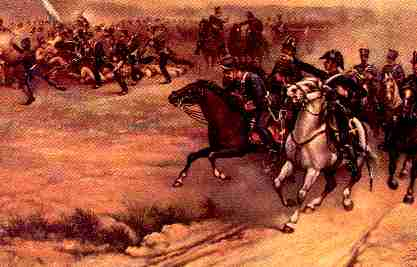
^^ this is a painting of the battle of Maipu. The caption on the site is "The United Argentine-Chilean army recovers and on April 5th they defeat completely the Spanish army in the battle of Maipu. That battle ended the Spanish efforts to dominate Chile."
from (http://pachami.com/English/maipu.jpg)
This site explains José de San Martín's correlation to the independence of Argentina. It also provides a sort of blow-by-blow description of the military side of the independence movement, including dates, which could prove to be very useful.
^^ this is a painting of the battle of Maipu. The caption on the site is "The United Argentine-Chilean army recovers and on April 5th they defeat completely the Spanish army in the battle of Maipu. That battle ended the Spanish efforts to dominate Chile."
from (http://pachami.com/English/maipu.jpg)
LAIM, deuxieme partie
(https://www.cia.gov/library/publications/the-world-factbook/geos/ar.html)
This is the CIA world factbook entry on Argentina, which includes a small overview of the history/independence of the country, as well as information about Argentina's current political situation.
(http://www.britannica.com/eb/article-33071/Argentina)
This is the Encyclopedia Britannica article on Argentinian independence. It is very clear-cut and understandeable, and presents a wealth of information on the topic. The article on Argentinean history as a whole is very extensive, even spanning back to the era of the Inca.
This is the CIA world factbook entry on Argentina, which includes a small overview of the history/independence of the country, as well as information about Argentina's current political situation.
(http://www.britannica.com/eb/article-33071/Argentina)
This is the Encyclopedia Britannica article on Argentinian independence. It is very clear-cut and understandeable, and presents a wealth of information on the topic. The article on Argentinean history as a whole is very extensive, even spanning back to the era of the Inca.
LAIM

from (http://en.wikipedia.org/wiki/Image:Flag-map_of_Argentina.svg)
(http://www.historyworld.net/wrldhis/PlainTextHistories.asp?historyid=ac09)
This site is like a mini-lecture on the history of Argentina, ranging from 1776 to 1916. It presents straightforward information on how the development of the state contributed to the independence movement.
Tuesday, October 2, 2007
textbook
I was reading my old biology textbook, and in it was included a wealth of information about the properties of water. Some of the topics covered by the book/ vocabulary words include:
-Electronegativity
-The polarity of Water
-Polar covalent bonds
-Water's polarity leads to hydrogen bonding and other unusual properties
-Hydrogen Bonds
-Cohesion
-Surface Tension
-Heat
-Temperatrue
-Ice is less dense than liquid water
-Water is the universal solvent
I will definitely bring the book into class, because it is very chemically involved and informative.
-Electronegativity
-The polarity of Water
-Polar covalent bonds
-Water's polarity leads to hydrogen bonding and other unusual properties
-Hydrogen Bonds
-Cohesion
-Surface Tension
-Heat
-Temperatrue
-Ice is less dense than liquid water
-Water is the universal solvent
I will definitely bring the book into class, because it is very chemically involved and informative.
Monday, October 1, 2007
script
Script (2)
[shot of crowd milling through HTH]
(Mari) Most people have a pre-formulated concept about the lives of migrant workers and illegal immigrants in the United States.
[shot of Mari in front of interviewees]
(Mari) So, __________, what kind of lives do you think that illegal immigrants lead?
(Three peer interviewees) _______________________________
[photographs of Great Depression]
(narration) Latin American workers, which will be the main focus of our segment, started coming to the states during the Great Depression. Due to the ruined financial state of the country, their wages were often extremely low, and the labor was time-intensive and rough. Conditions were unforgiving and workers were rarely able to better their lives, having to keep working to barely escape bankruptcy.
[pictures of newspapers with articles on illegal immigration]
In the last decade, the issue of illegal immigration has become more and more pressing, and more awareness has arisen towards the problems that occur with the increasing presence of a migrant labor force.
We at Working Class Heroes Productions are going to discuss the problems that specifically affect those workers, such as housing and wages.
[statistics on a background]
Economically, the united states is more dependant on the flow of migrant labor than many would imagine. According to the Inter-American Development Bank, migrant workers in the United States sent home a collective $62.3 billion dollars in 2006, which is a 14% increase from 2005. Mexico, Brazil, and Colombia have the highest receiving rate of remittances. With the pressing issue of illegal immigration however, the INDB estimates that the number of remittances will begin to decline, which could have negative effects on the economies of not only the recipients, but the United States as well.
Migrant farm workers as a whole do not have adequate housing, and the issue is often glossed over by the government.
[shot of immigrant housing, taken while in Mexico]
In some circumstances, employers are not required to provide housing for their workers, and thus, it is upon the migrant worker themselves to find shelter for their families, on a sub par minimum wage. Also, if the worker does not have legal status, housing seems an even bigger nuisance, as many land lords mandate that tenants provide proof of legal residence. Those who speak out against the assimilation of illegal immigrants into US society, such as groups like the minute men, argue that this is knowledge that all illegal immigrants choose to accept, and that should they obtain legal citizenship the proper way. However, the current legal process is a taxing and time consuming affair that can take several years. Meanwhile, outsourcing of work seems to be increasing at a rapid pace, and creates difficult situations for the people in countries of which many migrant workers originate from, creating a cyclical pattern of opportunity forming into exploitation.
[group member in front of interviewee]
Here, we interview ___person___ on the subject of migrant workers.
(interview questions here).
[shot of crowd milling through HTH]
(Mari) Most people have a pre-formulated concept about the lives of migrant workers and illegal immigrants in the United States.
[shot of Mari in front of interviewees]
(Mari) So, __________, what kind of lives do you think that illegal immigrants lead?
(Three peer interviewees) _______________________________
[photographs of Great Depression]
(narration) Latin American workers, which will be the main focus of our segment, started coming to the states during the Great Depression. Due to the ruined financial state of the country, their wages were often extremely low, and the labor was time-intensive and rough. Conditions were unforgiving and workers were rarely able to better their lives, having to keep working to barely escape bankruptcy.
[pictures of newspapers with articles on illegal immigration]
In the last decade, the issue of illegal immigration has become more and more pressing, and more awareness has arisen towards the problems that occur with the increasing presence of a migrant labor force.
We at Working Class Heroes Productions are going to discuss the problems that specifically affect those workers, such as housing and wages.
[statistics on a background]
Economically, the united states is more dependant on the flow of migrant labor than many would imagine. According to the Inter-American Development Bank, migrant workers in the United States sent home a collective $62.3 billion dollars in 2006, which is a 14% increase from 2005. Mexico, Brazil, and Colombia have the highest receiving rate of remittances. With the pressing issue of illegal immigration however, the INDB estimates that the number of remittances will begin to decline, which could have negative effects on the economies of not only the recipients, but the United States as well.
Migrant farm workers as a whole do not have adequate housing, and the issue is often glossed over by the government.
[shot of immigrant housing, taken while in Mexico]
In some circumstances, employers are not required to provide housing for their workers, and thus, it is upon the migrant worker themselves to find shelter for their families, on a sub par minimum wage. Also, if the worker does not have legal status, housing seems an even bigger nuisance, as many land lords mandate that tenants provide proof of legal residence. Those who speak out against the assimilation of illegal immigrants into US society, such as groups like the minute men, argue that this is knowledge that all illegal immigrants choose to accept, and that should they obtain legal citizenship the proper way. However, the current legal process is a taxing and time consuming affair that can take several years. Meanwhile, outsourcing of work seems to be increasing at a rapid pace, and creates difficult situations for the people in countries of which many migrant workers originate from, creating a cyclical pattern of opportunity forming into exploitation.
[group member in front of interviewee]
Here, we interview ___person___ on the subject of migrant workers.
(interview questions here).
Subscribe to:
Comments (Atom)